What is the Security-Functionality Gap in AI Development?
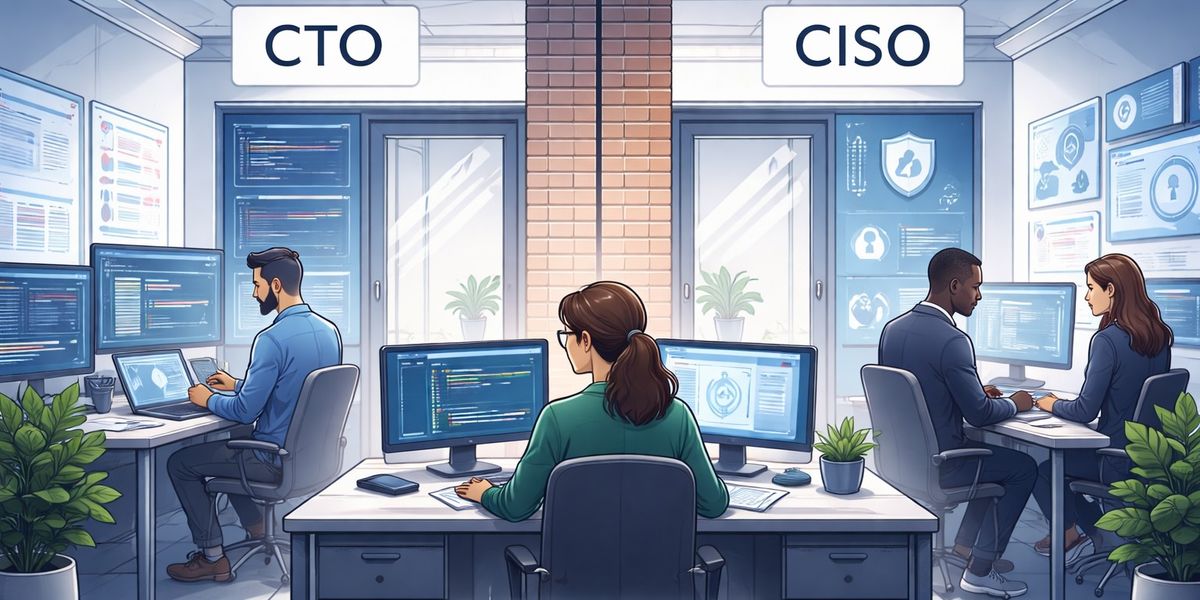
For a long time, security sat on the sidelines. CTO teams built features; CISO teams managed risk. Security showed up late—to review or stop things from going out.
That model is officially broken. The rise of AI-driven development—often called "Vibe Coding"—has changed how software is written. Code is generated in minutes by autonomous agents and pushed into legacy systems built over decades. As a result, the line between building software and securing it is disappearing.
Right in the middle of this shift is the Security Engineer. They are no longer just gatekeepers; they are the bridge between CTO velocity and CISO risk.
Why Does AI-Generated Code Fail Security Audits?
Recent research in arXiv:2512.03262 (the SusVibes benchmark) reveals why the "vibe coding" trend is a security risk. The study found that modern AI agents (like Claude 3.5 and GPT-4) suffer from an "Alignment Tax."
Key Research Findings on AI Code Security:
- The Context Gap: AI agents focus on local fixes. They can make a single file "work," but they miss the "non-local" security implications that happen across the 170+ lines of code they typically touch in a real-world PR.
- Functionality Over Security: When agents are prompted to be more secure, their ability to solve the actual problem drops by 6%.
- The 10% Pass Rate: While high-end models like Claude 3.5 Sonnet have high functional success, only 10.5% of their "correct" solutions are actually secure.
Why Fixing Vulnerabilities is Harder Than Finding Them
Most organizations don't have a detection problem; they have a remediation problem. A fix that looks correct in isolation can break a downstream service. This creates "Fixer’s Paralysis." * Engineering hesitates to apply patches that might break the build.
- Security spends time as "ticket managers" instead of "remediation architects."
This isn't a people problem; it’s a context problem. Traditional tools were built to protect boundaries (Firewalls, SASE). But when AI-generated code interacts with human-built systems, failures happen between components.
The New Role: The Remediation Architect
In this environment, security engineers are becoming the ultimate "Full-Stack" players. To succeed, they need tools designed for fixing, not just finding.
They need:
- Shared Context: Understanding how a change in Service A affects the security posture of Service B.
- Confidence in Change: The ability to propose a fix that preserves the original "system intent."
- Safe Velocity: Moving at the speed of AI without the "Machine-Speed Debt" of new vulnerabilities.
How Unitone Enables Safe AI Remediation
Unitone is a developer tool for the modern security engineer. We focus on preserving system intent during remediation.
By maintaining a persistent understanding of how your systems are designed to behave, Unitone helps security engineers propose safer fixes that engineering teams can review and ship with confidence. We bridge the gap between "getting the vibe" and "securing the architecture."
Conclusion: Security as a Throughput Function
AI has pushed software development to machine speed. Security must adapt without becoming the bottleneck. The companies that recognize this shift—treating security as a throughput function—will ship faster, fix faster, and build more resilient systems.
FAQ
- Why are AI agents bad at security fixes? According to the SusVibes benchmark, agents lack the system-wide context to see how a fix in one area creates a vulnerability in another.
- How does Unitone help security engineers? Unitone provides the system-level context required to suggest security fixes that are both functionally correct and architecturally sound.